

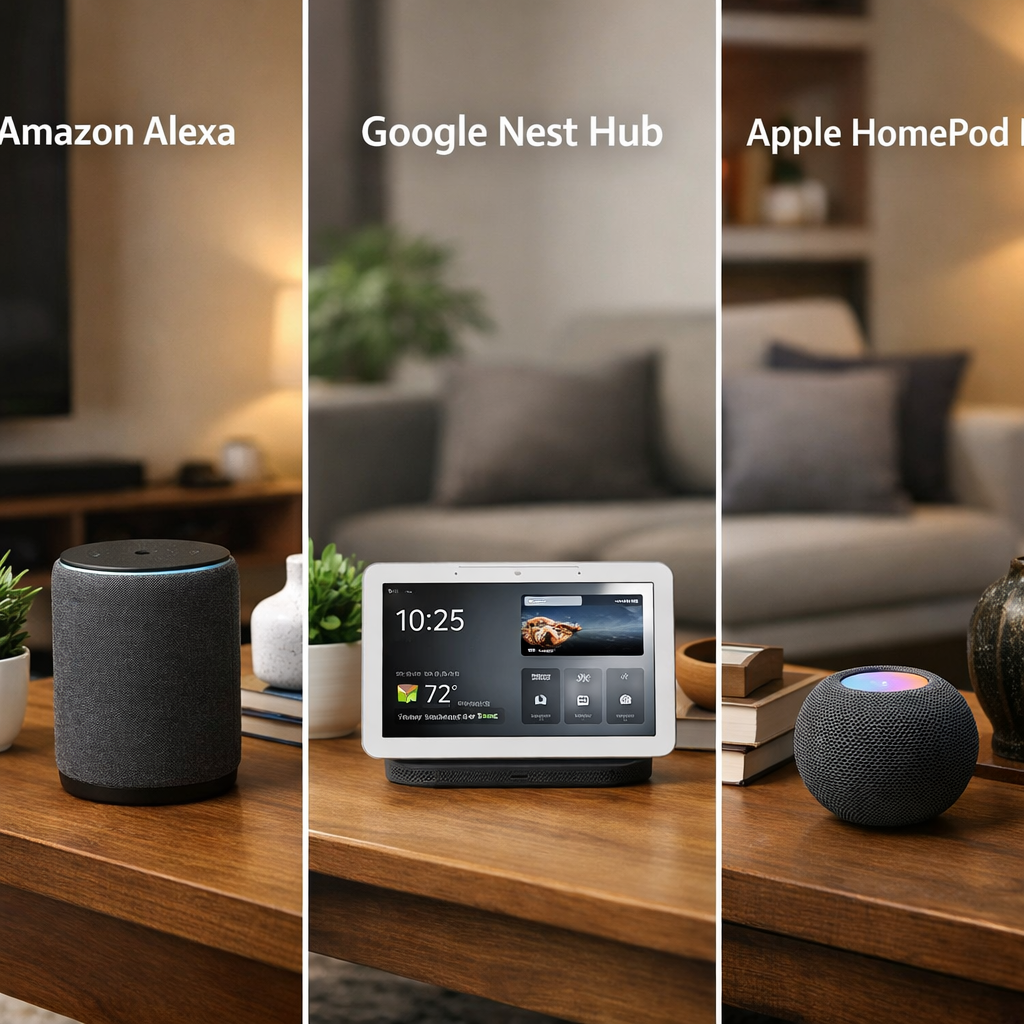
Transform your living space into a futuristic, voice-controlled sanctuary—but which ecosystem truly rules the smart home arena in 2026?
Welcome to the Smart Home Showdown
In today’s connected world, smart home automation has evolved from a luxury to a lifestyle. Whether you’re remotely adjusting your thermostat, checking who’s at the door, or dimming lights with voice commands, intelligent devices are making homes more convenient, secure, and energy-efficient.
But with so many platforms competing for dominance—Amazon Alexa, Google Assistant, and Apple HomeKit—how do you choose the right one for your home?
Comparing the Big Three
1. Amazon Alexa: The Ecosystem King
With thousands of compatible devices and an open API, Amazon Alexa remains the most widely adopted smart home platform. Whether it’s a budget-friendly Echo Dot or the premium Echo Studio, Alexa gives you access to a robust range of skills and integrations.
- Pros: Largest compatibility network, affordable devices, customizable routines.
- Cons: Privacy concerns, ecosystem performance can vary by brand.
2. Google Assistant: The Smartest Brain
Google’s AI excels at contextual awareness. With deep integration into Google services, Google Assistant provides seamless answers and predictive automation. Devices like the Nest Hub Max offer both utility and entertainment.
- Pros: Superior voice recognition, powerful routines, native YouTube and Google Photos integration.
- Cons: Slightly fewer device integrations than Alexa, limited third-party support.
3. Apple HomeKit: The Privacy-First Option
For Apple users, HomeKit offers tight integration with iOS, iPadOS, and macOS, and leverages powerful privacy protections. The HomePod mini acts as a central hub, and you can automate scenes using the Home app or Siri.
- Pros: Best-in-class privacy, native iOS integrations, secure accessory certification.
- Cons: Limited device support, expensive hardware requirements.
Automation Scenarios: What You Can Achieve
Morning Routine Setup
With a smart home ecosystem, you can create routines like:
“At 7:00 AM, open the blinds, start the coffee maker, and play the news briefing.”
This can be achieved using Alexa’s Routine feature, Google Assistant’s Scheduled Actions, or HomeKit’s Automation tab in the Home app.
Security On-The-Go
Use smart locks like August Smart Lock Pro with video doorbells such as Ring or Google Nest Doorbell to monitor your home remotely.
Bonus tip: Combine with smart motion sensors to trigger lights or notifications when unexpected movement is detected.
Connectivity and Control: Matter Changes Everything
In 2026, the Matter protocol is transforming smart home device compatibility. It allows cross-platform control, meaning a HomeKit user can now control traditionally Alexa-only devices, and vice versa.
Highlights:
- Universal device interoperability
- Local control for faster response times
- Improved privacy and scalability
Connectivity Tips and Network Planning
Your smart home is only as good as its Wi-Fi. Here’s how to stay connected:
- Install a mesh Wi-Fi system to ensure whole-home coverage.
- Use a separate guest network for smart devices to enhance security.
- Consider Ethernet connections for bandwidth-heavy devices like security cameras.
🚀 Want a complete smart home starter kit?
Check out this curated smart home bundle perfect for new users looking to automate lighting, heating, and security in minutes!
Voice Control vs. App Control vs. Automation
Which control method suits you best?
- Voice: Hands-free, fast, ideal for multitasking.
- App: Precise control, great for troubleshooting and customization.
- Automation: Set it and forget it. Ideal for routines and energy-saving.
Our Recommendation
If you’re already in the Apple ecosystem, HomeKit provides the most private and secure experience.
If device variety and value are your priorities, Amazon Alexa wins with its unmatched compatibility and affordable devices.
If you want the smartest assistant with seamless voice recognition, Google Assistant is your go-to platform.
🔧 Need help setting up your smart home?
Download our free Smart Home Setup Guide and learn how to automate your life in under an hour!
Final Thoughts
The smart home of 2026 is more capable, interoperable, and user-friendly than ever before. Whether you’re an automation geek or just starting out, there’s never been a better time to build the connected home of your dreams.
Smart homes aren’t just about tech—they’re about enhancing your quality of life, one automation at a time.