

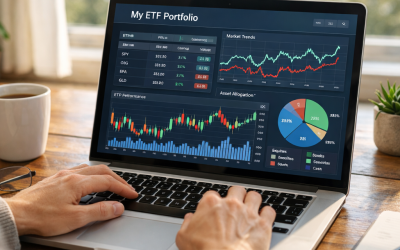
With market volatility on the rise and crypto assets swinging wildly, exchange-traded funds (ETFs) offer a stable and diversified pathway to long-term financial growth. Learn how to invest smart in 2025.
Why ETFs Matter in Today’s Market
Despite the recent rebound in crypto markets and Bitcoin surging past $92K, traditional investors continue to seek structured, lower-volatility vehicles for long-term wealth building. This is where exchange-traded funds (ETFs) shine. Offering diversification, liquidity, and low costs, ETFs are an ideal asset class for any modern portfolio.
Understanding the Basics: What is an ETF?
An ETF is a marketable security that tracks an index, sector, commodity, or other assets, but trades like a stock. Popular examples include the SPDR S&P 500 ETF (SPY) and the Vanguard Total Stock Market ETF (VTI). ETFs combine the flexibility of individual stocks with the diversification benefits of mutual funds.
Key ETF Strategies to Consider in 2025
1. Core-Satellite Portfolio Strategy
This approach involves building a “core” of broad-market ETFs to provide stability and layering in “satellite” ETFs to target specific sectors, themes, or geographic regions. For example:
- Core ETF: VTI – Vanguard Total Market ETF
- Satellite ETF: ICLN – iShares Global Clean Energy ETF
- Crypto Exposure: Consider crypto-adjacent ETFs like Global X Blockchain ETF (BITS)
2. Thematic Investing
Thematic ETFs allow investors to capitalize on long-term societal and technological trends. In 2025, the most promising themes include:
- Artificial Intelligence: AIQ – Global X Artificial Intelligence ETF
- Green Energy: ICLN – iShares Global Clean Energy ETF
- Web3 and Blockchain: BLOK – Amplify Transformational Data Sharing ETF
3. Dollar-Cost Averaging (DCA)
Instead of trying to time the market, DCA involves investing a fixed amount into your chosen ETFs at regular intervals. This reduces the impact of volatility and helps you buy more shares when prices are low.
Example: Investing $500/month into VTI regardless of market conditions helps smooth out your average cost per share over time.
How to Analyze an ETF Before Investing
Use the following criteria to evaluate an ETF’s merit:
- Expense Ratio: Lower is better. Anything under 0.20% is considered low-cost.
- Liquidity: Check average daily volume. High volume ensures ease of buying or selling without impacting price.
- Holdings: Review the top 10 assets in the ETF to understand exposure.
- Performance History: While past performance isn’t a guarantee, it gives insights into volatility and returns.
Use tools like ETF.com or Morningstar ETF Center for analysis.
ETFs vs. Mutual Funds vs. Stocks
| Feature | ETFs | Mutual Funds | Individual Stocks |
|---|---|---|---|
| Diversification | High | High | Low |
| Fees | Low | Medium to High | Low |
| Trading Flexibility | Intraday | End of Day | Intraday |
| Risk | Moderate | Moderate | High |
Tax Advantages of ETFs
ETFs are generally more tax-efficient than mutual funds due to their unique structure. Through in-kind transfers, they avoid triggering capital gains during rebalancing — a valuable advantage in taxable accounts.
CTA #1: Ready to start building your ETF portfolio?
Open a free Vanguard account and start investing in low-cost, diversified ETFs today.
Risk Management in ETF Investing
While ETFs are less risky than individual stocks, they still carry market risk. Diversify across asset classes, use stop-loss orders where appropriate, and regularly rebalance your portfolio to align with your risk tolerance and investment goals.
Crypto ETFs: A Cautious Opportunity
With institutional activity climbing and tokenized assets reaching new highs, crypto ETFs like BITO (Bitcoin Strategy ETF) offer exposure without dealing directly with wallets or exchanges. However, these ETFs carry higher volatility and should be considered speculative.
CTA #2: Want to test ETF investing without real money risk?
Try a free ETF simulator from Investopedia to build your skills and confidence.
Conclusion: The Time to Start is Now
In a world of economic uncertainty and evolving technologies, ETFs provide an efficient, flexible way to invest in growth, manage risk, and build long-term wealth. Whether you’re just starting or refining your portfolio, adopting a smart ETF strategy in 2025 could be one of the best financial decisions you make.
Start today, stay consistent, and let compounded returns work for you.


0 Comments