
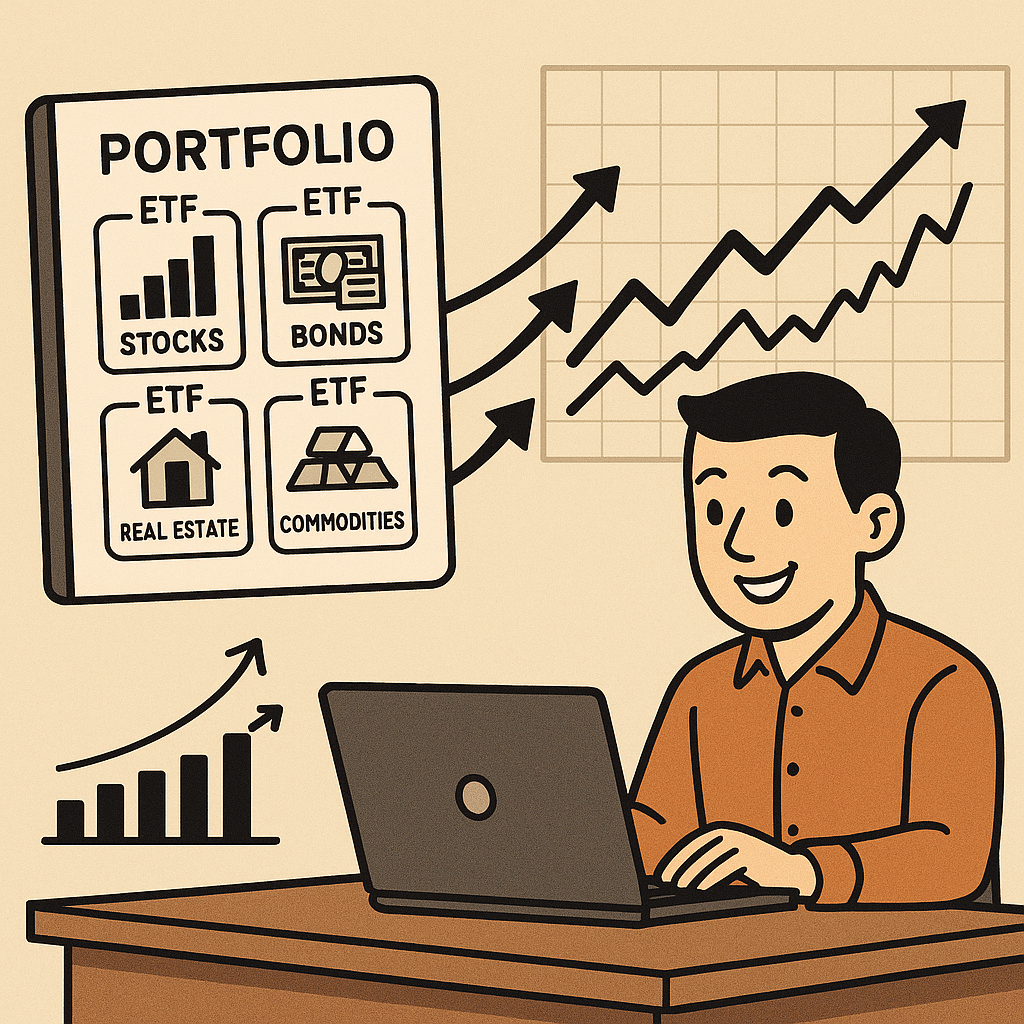

Want to grow your wealth without picking individual stocks? Discover how ETFs can simplify your investment journey and deliver solid returns over time.
Why ETFs Are a Smart Choice for Modern Investors
Exchange-Traded Funds (ETFs) have revolutionized the way individuals invest. Combining the diversification benefits of mutual funds with the trading flexibility of stocks, ETFs offer a powerful vehicle for both novice and seasoned investors. As markets become increasingly volatile and complex, ETFs give investors a cost-effective and transparent way to gain exposure to various asset classes.
What Exactly Is an ETF?
An ETF is a basket of securities—like stocks, bonds, and commodities—that you can buy and sell on a stock exchange. Most ETFs track an index, such as the S&P 500 or the MSCI Emerging Markets Index. Because ETFs are passively managed, they typically come with lower fees than actively managed mutual funds.
Benefits of Investing in ETFs
- Diversification: Spread your risk across multiple assets without having to buy each one individually.
- Liquidity: ETFs can be traded throughout the trading day like a stock.
- Transparency: Most ETFs disclose their holdings daily.
- Cost-Effectiveness: Low expense ratios help you keep more of your returns.
Popular ETF Investment Strategies
1. Core-Satellite Strategy
This strategy involves using broad market ETFs as the ‘core’ of your portfolio, supplemented with more specialized or thematic ETFs as ‘satellites.’ For example:
- Core: Vanguard Total Stock Market ETF (VTI)
- Satellite: ARK Innovation ETF (ARKK) or Global X Lithium & Battery Tech ETF (LIT)
2. Factor Investing
Factor ETFs target specific investment styles like value, growth, momentum, or low volatility. For instance:
3. Thematic Investing
Invest in powerful macro trends like clean energy, AI, or blockchain. Thematic ETFs include:
How to Build a Diversified ETF Portfolio
Here’s a sample ETF portfolio for a moderately aggressive investor with a long-term horizon:
| Asset Class | ETF Example | Allocation |
|---|---|---|
| US Equities | VTI | 40% |
| International Equities | VXUS | 20% |
| Fixed Income | AGG | 20% |
| Real Estate | VNQ | 10% |
| Commodities | GLD (Gold) | 10% |
How to Begin Your ETF Investment Journey
- Open a brokerage account: Consider platforms like Fidelity, Charles Schwab, or Vanguard.
- Define your investment goals: Retirement, wealth accumulation, passive income, etc.
- Decide on your risk tolerance: Conservative, moderate, or aggressive.
- Choose your ETFs: Based on your risk profile and investment horizon.
- Automate contributions: Set up a recurring investment schedule—weekly, bi-weekly, or monthly.
✅ Ready to Get Started?
Open a free brokerage account today and start investing in ETFs with as little as $50.
Tax Efficiency and Rebalancing
ETFs are typically more tax-efficient than mutual funds because of their in-kind redemption process. Still, to optimize returns:
- Use tax-advantaged accounts: Like Roth IRA or 401(k).
- Harvest tax losses: Sell losing ETFs strategically to offset capital gains.
- Rebalance annually: Maintain your target asset allocation by selling overperformers and buying underperformers.
Common Mistakes to Avoid
- Chasing performance: Just because an ETF did well last year doesn’t mean it will continue.
- Over-diversification: Holding too many overlapping ETFs can dilute returns.
- Ignoring fees: Always compare expense ratios before buying.
Where Are ETFs Headed?
With more investors seeking passive and thematic exposure, the ETF market is expected to grow significantly. Innovations like tokenized assets and crypto ETFs are on the rise, opening new frontiers for diversified investing.
💡 Bonus: Learn How ETFs Compare to Mutual Funds
Check out this ETF vs Mutual Fund guide on Investopedia to make informed decisions.
Final Thoughts
ETFs are a robust investment tool that can fit nearly any portfolio goal. Whether you’re saving for retirement or building generational wealth, ETF strategies offer flexibility, low costs, and diversification. With the right plan and discipline, you can make ETFs the backbone of a successful long-term investment strategy.
Start small. Stay consistent. And let the power of compounding work its magic.



0 Comments