
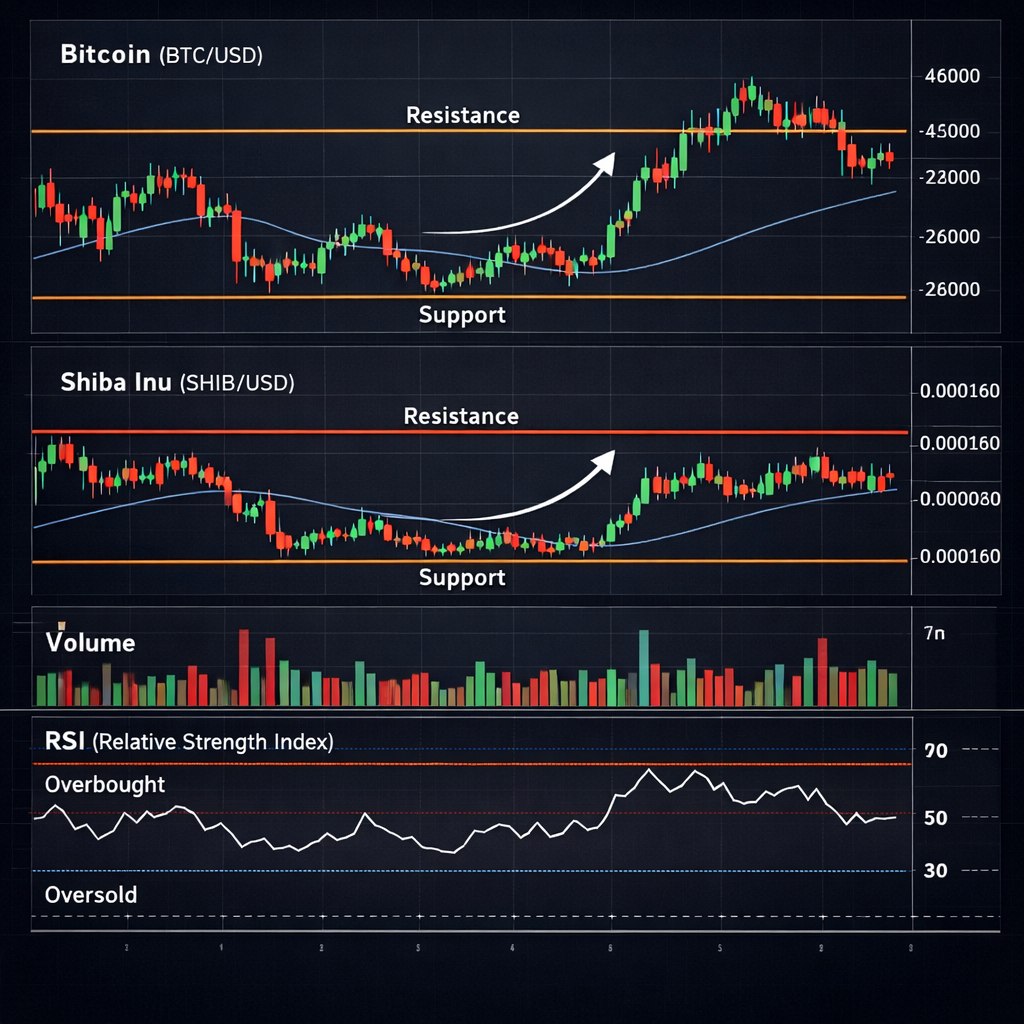

Are you relying on hype instead of strategy? Discover how to decode crypto price charts, identify key support and resistance levels, and build a smarter trading plan — even in volatile conditions.
Understanding the Power of Technical Analysis in Crypto
In the ever-evolving crypto market, emotions can be your worst enemy. Whether it’s the Bitcoin dip below $80K or meme coins like Shiba Inu testing key support levels, price movements can trigger panic — or opportunity, if you’re prepared.
Technical analysis (TA) helps you cut through the noise. It’s the art of using historical price and volume data to forecast potential future market moves. Let’s break down how to use simple TA tools to make smarter trades in any market condition.
Key Concepts Every Crypto Trader Should Know
- Trendlines: These help identify the direction of the market — upward, downward, or sideways.
- Support and Resistance: Key price levels where the asset historically finds buying (support) or selling (resistance) pressure.
- Volume: High volume on price moves often confirms the strength of that move.
- Indicators: Tools like RSI, MACD, and Moving Averages are critical to understanding momentum and trend shifts.
Chart Reading Basics: Spotting Entry and Exit Zones
Let’s walk through a common scenario. Shiba Inu is currently retesting a key support level inside a parallel channel, as noted by analysts (source). What does that mean for you?
- Draw the channel: Use tools like TradingView (see TradingView) to identify two parallel trendlines. If SHIB is bouncing at the lower trendline, it could be a buy zone.
- Look at RSI: If RSI is below 30, the asset is likely oversold — a bullish signal if supported by volume.
- Set stop-loss: Place stop-loss just below the channel to limit downside risk.
Pro Tip: Wait for confirmation! A bounce with high volume or a bullish candlestick pattern (like a hammer or bullish engulfing) increases the chance of a successful trade.
Trading Strategy 1: The Pullback Play
Perfect for volatile markets like we’re seeing with Bitcoin’s drop to $74K.
- Step 1: Identify a strong uptrend using the 50-day and 200-day Moving Averages.
- Step 2: Wait for a pullback to a key moving average or previous resistance turned support.
- Step 3: Buy on the bounce with confirmation (e.g., bullish candle, volume spike).
- Step 4: Target previous highs and use a trailing stop.
Example: Bitcoin bouncing off the 200-day MA after ETF inflows show institutional interest — a pullback play backed by fundamentals and technicals.
Trading Strategy 2: Breakout Strategy with Volume Confirmation
Breakouts can be powerful — but only if they’re real.
- Step 1: Identify a consolidation zone or chart pattern like a triangle or wedge.
- Step 2: Watch for a breakout above resistance or below support.
- Step 3: Confirm with volume. No volume = potential fakeout.
- Step 4: Enter on the breakout, place stop-loss inside the pattern, and set a measured move target.
Case Study: MaxiDoge ($MAXI) defied the market sell-off (see article) — this signals strength. A breakout trader would look for consolidation followed by volume-driven upward movement.
How to Read Candlestick Patterns
Candlestick charts show the battle between bulls and bears. Some key formations to know:
- Doji: Indecision; possible trend reversal.
- Hammer: Bullish reversal after a downtrend.
- Shooting Star: Bearish reversal after an uptrend.
- Bullish/Bearish Engulfing: Strong signals of trend change.
Combine these with support/resistance zones for great results.
Risk Management: Protecting Your Capital
Even the best setups fail. That’s why risk management is your lifeline:
- Never risk more than 1-2% of your portfolio per trade.
- Use stop-loss orders religiously.
- Set realistic targets based on chart structure — use the risk/reward ratio (aim for 2:1 or better).
Take control of your trades — don’t just follow influencers or price pumps. Build your own data-backed strategy.
Using On-Chain Data as Technical Confirmation
On-chain analytics tools like Checkonchain offer macro insights. For example, their recent report shows that Bitcoin’s drop below key averages may signal deeper bear market movement (read more). That type of info enhances your TA with long-term context.
Combine on-chain with technical analysis for smarter long-term entries. Look for alignment between price structure and network activity.
Bonus: How Regulation is Changing the Game
The recent MiCA regulation in Europe has opened the door for traditional investors. For example, ING Germany now allows crypto trades like buying index funds. This institutional flow can create major TA signals — such as breakouts on high volume and trend continuation.
Actionable Tip: Watch the charts of crypto ETFs and ETNs. They offer clean technical setups with less manipulation than smaller altcoins.
Start Practicing Today
Want to apply what you’ve learned? Start by picking one coin in a strong trend (like BTC or ETH), draw support and resistance zones, identify the trend, and place a mock trade using a free demo account on platforms like TradingView or Bybit.
📌 Tip: Keep a trade journal. Document your reasoning, indicators used, and results. Over time, you’ll refine your edge.
Don’t Just Trade — Trade Smarter
The crypto market rewards preparation, not prediction. By learning to read charts, using key indicators, and implementing sound risk management, you can navigate volatility with confidence.
Looking to level up? Subscribe to our weekly Crypto TA Digest for chart breakdowns, strategy guides, and exclusive insights. Join here.
And if you’re serious about consistency, check out our free downloadable crypto trading journal template. Track your wins, losses, and patterns to improve faster. Download the template.





0 Comments