
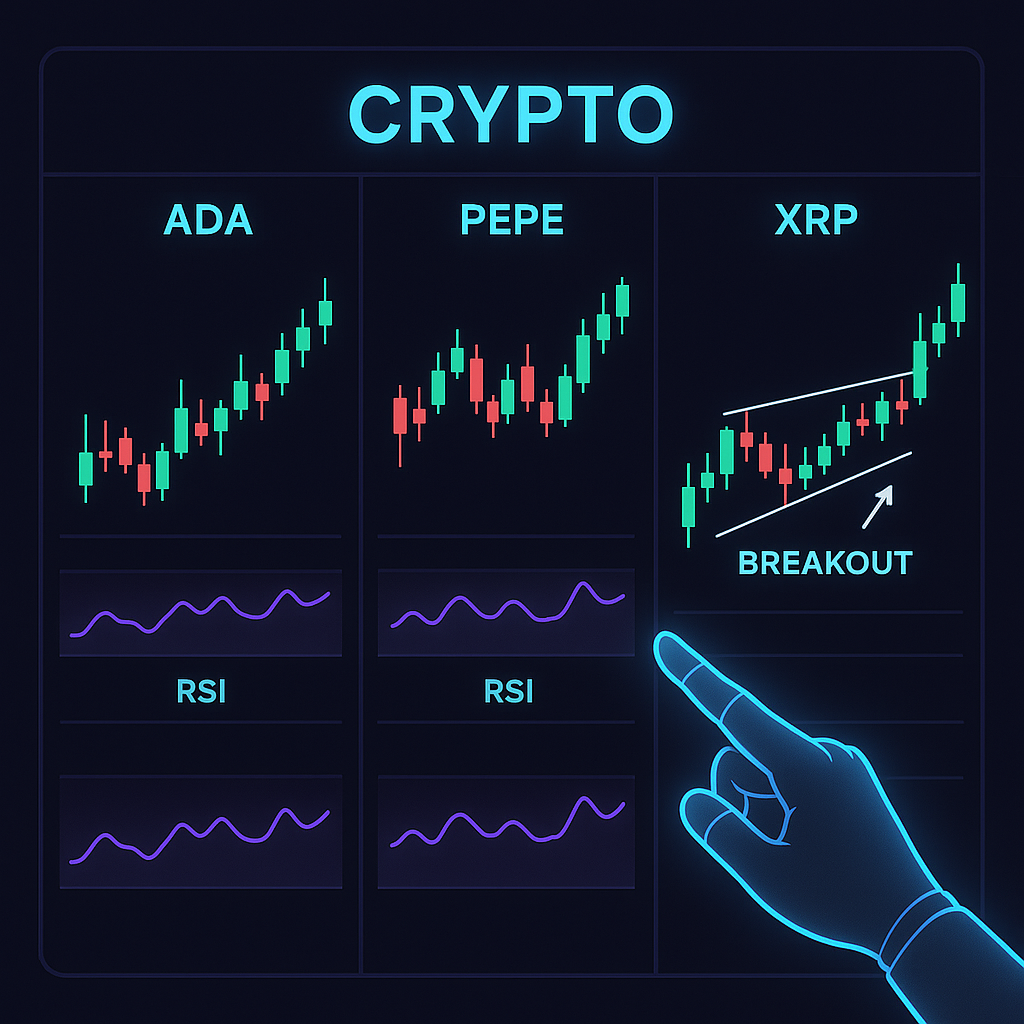

Want to know when to buy or sell your favorite altcoin like ADA, PEPE, or XRP? Learn how to read crypto charts like a pro and turn price trends into real profits—no guesswork, no hype.
Why Technical Analysis is Critical in Crypto Trading
In a volatile market like crypto, hype and headlines can mislead even the most enthusiastic investors. From Cardano’s resilience to PEPE’s surprise bounce, there’s always noise. Technical analysis (TA) helps you cut through that noise and make informed decisions based on price patterns, volume, and momentum—not just narratives.
Step 1: Know Your Chart Types
Before you begin analyzing, make sure you understand the basic chart types:
- Line Charts: Simplistic and ideal for beginners. Shows closing prices over time.
- Bar Charts: Offers more data points like open, high, low, and close (OHLC).
- Candlestick Charts: Most popular for crypto traders. Helps visualize market psychology with color-coded candles.
Pro Tip: Use platforms like TradingView or CoinMarketCap charts for real-time visual analysis.
Step 2: Understand Market Phases
Markets don’t move randomly. They go through four key phases:
- Accumulation: Smart money buys low before a breakout.
- Markup: Price rises as retail investors enter the market.
- Distribution: Early buyers start selling; volume remains high.
- Markdown: Price drops as selling intensifies.
Knowing these phases helps you avoid buying the top or panic-selling the bottom.
Step 3: Key Indicators You Must Know
1. Moving Averages (MA)
Helps smooth out price action. Popular types include:
- Simple Moving Average (SMA): Great for tracking longer-term trends.
- Exponential Moving Average (EMA): Gives more weight to recent prices. Useful for fast-moving altcoins like PEPE or SHIB.
Strategy: Watch for crossovers. When the 50-day EMA crosses above the 200-day EMA, it signals a bullish trend (aka Golden Cross).
2. Relative Strength Index (RSI)
Measures overbought or oversold conditions. Values range from 0–100.
- Above 70: Overbought – consider taking profits.
- Below 30: Oversold – potential buy opportunity.
Example: In the recent PEPE bounce, RSI showed an oversold condition, foreshadowing the 17% rebound.
3. MACD (Moving Average Convergence Divergence)
Tracks momentum through the interaction of two EMAs (usually 12 and 26-day) and a signal line.
Buy Signal: When MACD line crosses above the signal line.
Sell Signal: When MACD line crosses below the signal line.
Step 4: Support and Resistance Zones
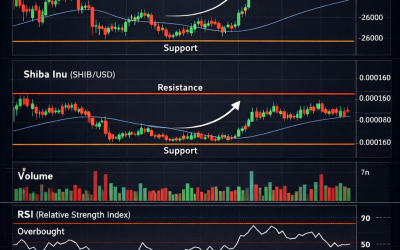
Support = price level where buying pressure prevents further decline.
Resistance = level where selling pressure prevents further rise.
These levels often align with previous highs/lows or Fibonacci retracement zones.
Tip: Use these levels to set stop-loss and take-profit targets.
Step 5: Volume Analysis – The Trader’s Lie Detector
Volume confirms price movement.
- Rising Price + Rising Volume: Strong bullish signal.
- Rising Price + Falling Volume: Watch out—trend may be weakening.
CTA #1: 🧠 Master chart reading on Binance Learn and give your trades a technical edge!
Real Market Examples from December 2025
Cardano (ADA)
Despite volatility, Charles Hoskinson remains bullish. ADA is forming a bullish ascending triangle on its daily chart. A breakout above the $0.60 resistance could trigger a run toward $0.75.
Action Tip: Place a buy stop just above resistance and set a stop-loss slightly below the triangle’s support.
PEPE
Bounced off a yearly low with a 17% gain. The RSI showed strong divergence, suggesting a reversal. Volume increased, confirming the move.
Action Tip: Look for a bullish MACD crossover and enter with a tight stop-loss under the previous low.
XRP
Institutional demand is flowing into XRP ETFs, pushing prices up. According to this report, XRP could be gearing up for a violent breakout.
Chart Setup: Bull flag formation spotted on 4-hour chart. Entry after breakout above flag resistance.
Bonus: Risk Management for Altcoin Traders
Even perfect technical setups can fail. That’s why risk management is vital.
- Use Stop-Losses: Define your risk per trade (e.g., 2% of total capital).
- Don’t Overleverage: 3x or lower is safer for beginners.
- Position Sizing: Allocate smaller amounts to highly volatile coins like SHIB or PEPE.
Top Free Tools for Technical Analysis
- TradingView – for live charts and community scripts
- CoinGecko – market overviews with technical indicators
- CryptoPanic – news aggregator with sentiment filters
Conclusion: Build a Repeatable, Data-Driven Strategy
Whether you’re looking to turn $100 into $10,000 with the next altcoin or avoid being wrecked by exploits like the Shiba Inu hack, technical analysis empowers you to make smarter trades.
Start practicing what you’ve learned today:
- Pick your favorite altcoin (ADA, PEPE, XRP)
- Analyze its chart using RSI, MACD, and trendlines
- Set your entry, stop-loss, and take-profit levels
CTA #2: 🚀 Want to test your skills? Try mock trading with real-time charts on Binance and build confidence—no risk involved!
Remember: Technical analysis doesn’t guarantee profits, but it dramatically improves the odds of success. Combine it with solid risk management, and you’ll be ahead of 90% of retail traders.



0 Comments