

Ever wondered why your trades seem to miss the mark? The secret might lie in your charts. Learn how to decode price action and use proven technical tools to make smarter crypto trading decisions—even in uncertain markets.
Introduction: Why Technical Analysis Matters in Crypto Trading
In a highly volatile market like crypto, technical analysis (TA) gives traders a data-driven edge. Whether you’re swing trading XRP or scalping Bitcoin in a choppy market, understanding price patterns and indicators is essential.
Recent news, such as the market’s slight uptick to $3.2 trillion or Wall Street’s growing dominance in Bitcoin liquidity, shows one thing: the market is maturing. So should your strategy.
Step 1: Understand Candlestick Basics
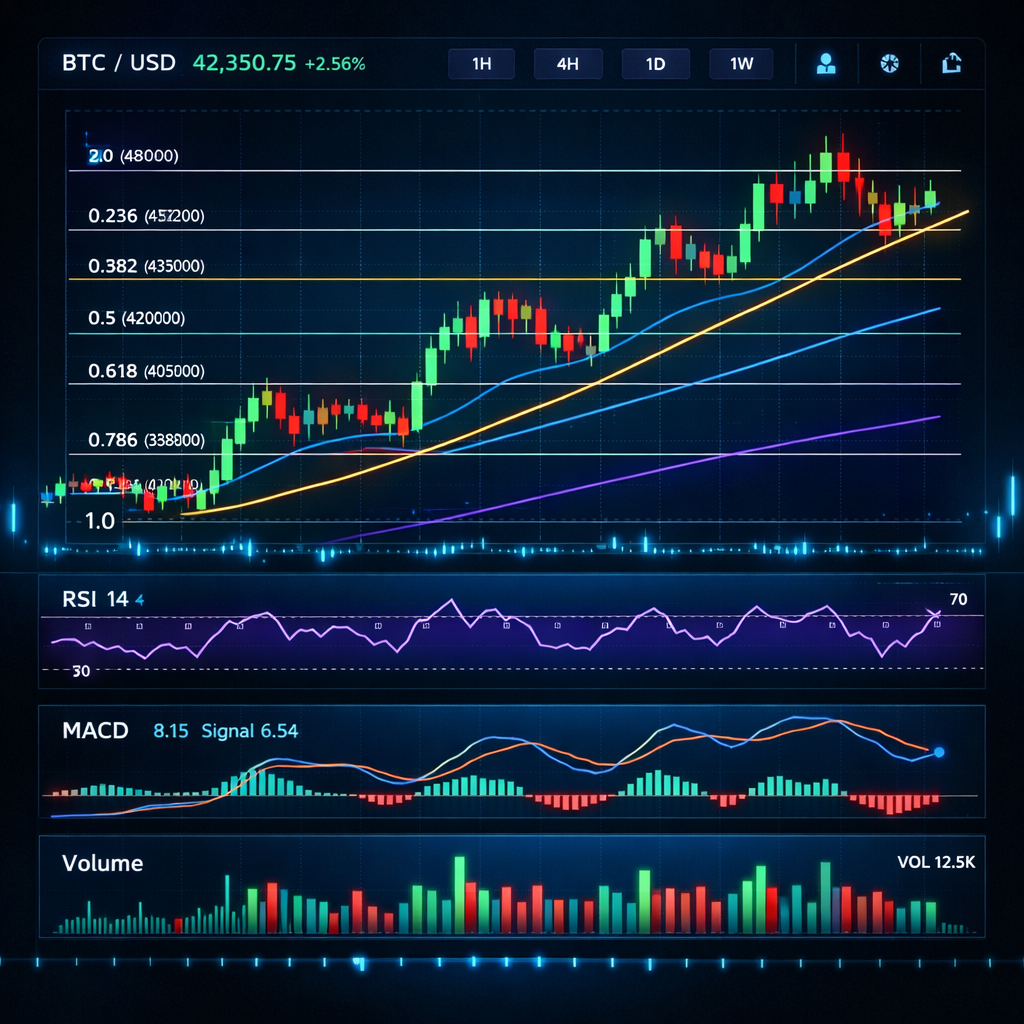
Candlesticks aren’t just visual flair. They show open, high, low, and close prices (OHLC) for a given time frame. Here’s how to interpret them:
- Green candle: Close is higher than open (bullish).
- Red candle: Close is lower than open (bearish).
- Wicks: High and low points of volatility.
To practice, use free tools like TradingView and apply different timeframes: 15m, 1h, 4h, and daily.
Step 2: Identify Trends with Moving Averages
Moving Averages (MAs) help smooth out price data so you can understand trends clearly:
- Simple Moving Average (SMA): Average price over time.
- Exponential Moving Average (EMA): Gives more weight to recent prices.
Strategy tip: Use a 50 EMA and 200 EMA combo. A 50 crossing above 200 indicates a bullish crossover—a possible buy signal.
Step 3: Use RSI to Spot Overbought and Oversold Zones
The Relative Strength Index (RSI) measures the speed and change of price movements. It ranges from 0 to 100:
- Above 70: Overbought (potential sell signal)
- Below 30: Oversold (potential buy signal)
Example: XRP recently held strong at $2.10 with consolidation. If RSI drops below 30 while price holds steady, it could be a buy-the-dip opportunity as hinted in this XRP price analysis.
Step 4: Learn to Spot Support and Resistance Zones
Support: A price level where demand is strong enough to prevent price from falling further.
Resistance: A price level where selling pressure prevents further price increases.
Use horizontal lines on charts to mark these key zones. Combine with volume and RSI to confirm strength.
Tip: Volume spikes at support zones often signal a reversal.
Step 5: Use Volume for Confirmation
Volume is the heartbeat of a move. It tells you whether a breakout or breakdown is likely to sustain.
- High volume breakout: Validates the move — possible follow-through.
- Low volume breakout: Likely fake-out — be cautious.
Case in point: MEXC’s $200,000 P2P airdrop may attract new users and spike volume. Watch for unusual volume on altcoins listed there.
Step 6: MACD for Momentum and Entry Timing
The Moving Average Convergence Divergence (MACD) shows momentum, trend direction, and entry signals.
- Signal crossover: When MACD line crosses above signal, it’s bullish. Below is bearish.
- Histogram bars: Measure momentum. Larger bars = stronger trend.
Combine with RSI for high-confidence entries.
Step 7: Fibonacci Retracement for Entry Zones
The Fibonacci levels (23.6%, 38.2%, 61.8%) are used to predict pullback zones in trending markets.
How to use: Draw Fib tool from swing low to high. Entry zones are often around the 61.8% or 50% levels.
Great for planning entries in bullish markets—especially when paired with sentiment signs like the South Korean policy reversal, signaling institutional interest.
Step 8: Combine Tools into a Simple Strategy
Here’s how to integrate all the above into a simple yet powerful strategy:
- Identify trend: Use 50/200 EMA on 4H chart.
- Confirm momentum: Use MACD + RSI.
- Find entry: Fibonacci + Support Zone + Volume spike.
- Set exit: Resistance level or RSI > 70.
Backtest it. Use historical XRP or BTC data on TradingView. No need to risk capital until you’re confident.
Practical Example: XRP Trade Setup
Let’s apply the strategy to XRP:
- Trend: Sideways above 200 EMA, slightly bullish.
- MACD: Shows bullish crossover on 1H chart.
- RSI: Near 40 (not overbought).
- Support: Holding $2.10.
→ Strategy: Place a buy order near $2.10 with a target of $2.40. Stop-loss just below $2.00.
Want to learn how to automate this? Explore TradingView scripts or use bots with rules based on these indicators.
Mindset and Risk Management
Even the best setup can fail. That’s why you must manage risk:
- Don’t risk more than 1-2% of your capital per trade.
- Use stop-loss orders religiously.
- Track every trade in a journal.
Stay consistent. The goal is not to win every trade—it’s to win more than you lose and let winners run.
Bonus Tip: Watch News for Volatility Triggers
News is a catalyst. Events like ETF approvals, airdrops, or regulatory shifts (like South Korea lifting crypto bans) can create powerful volatility—and opportunity.
Pro tip: Use an economic calendar and crypto-specific news feeds to anticipate events that could impact your charts.
Conclusion: Time to Level Up
You don’t need to predict the market—you just need to understand what it’s telling you through the charts. With candlesticks, moving averages, RSI, MACD, and Fibonacci tools, you’re now equipped to make smarter, more confident trading decisions.
Ready to apply these skills in real-time? Sign up at a beginner-friendly platform like MEXC and start practicing with rewards like their recent $200,000 airdrop.
📈 Want more trading setups, alerts, and weekly strategies? Join our free newsletter and never miss a profitable move. [Insert newsletter signup link]



0 Comments