


With Bitcoin flirting with $90,000, Ethereum’s staking queues jammed, and XRP’s stealth setup frustrating traders, 2026 is shaping up to be a year where technical analysis could make or break your portfolio. Ready to decode the charts and find your edge?
Understanding Market Context: Why 2026 Is Different
As we enter 2026, crypto markets are experiencing heightened volatility and divergence between price action and institutional behavior. Bitcoin is hovering around $87,000 after testing $90,000, while XRP is underperforming despite heavy institutional buying. Meanwhile, Ethereum is facing network congestion due to massive validator activity from a single corporate treasury. These dynamics underline the importance of technical analysis and chart reading to make informed decisions in uncertain times.
Step 1: Learn to Read Candlestick Charts
Candlestick charts are the default chart type for crypto trading. Each candle represents price activity over a set time period (e.g., 4h, 1d, 1w). Here’s how to interpret them:
- Green (or white) candle: Closing price is higher than the opening price (bullish).
- Red (or black) candle: Closing price is lower than opening (bearish).
- Wick (shadow): Shows the high/low range beyond the open and close prices.
Patterns to watch include:
- Doji: Signals indecision – look for confirmation before trading.
- Engulfing: A large candle that fully contains the prior one – bullish or bearish reversal signal.
- Hammer/Inverted Hammer: Potential reversal at trend bottoms or tops.
Pro Tip: Combine candlestick patterns with volume for stronger signals. Low volume = weak pattern.
Step 2: Use Key Indicators (But Don’t Overload)
Indicators help you confirm chart patterns. Here are three essential ones:
- RSI (Relative Strength Index): Measures momentum. Overbought (>70) or oversold (<30) zones often precede reversals. Learn More
- MACD (Moving Average Convergence Divergence): Detects trend strength and direction. Look for crossovers between MACD and signal line.
- Volume: High volume confirms trends. Divergence between price and volume often signals fake-outs or reversals.
Important: Don’t stack too many indicators. Use 2–3 max in combination with price action.
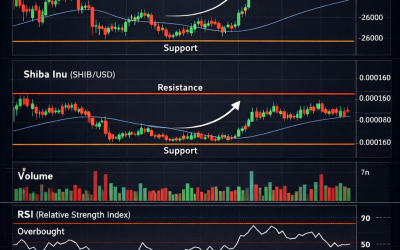
Step 3: Spot Support and Resistance Levels
Support is a price level where buyers step in. Resistance is where sellers take profits. These zones help you:
- Plan entry and exit points
- Set stop losses
- Identify breakout or fakeout scenarios
Tools like TradingView allow you to draw horizontal lines or use the Fibonacci retracement tool to detect these levels.
Example: Bitcoin recently struggled to break past $90K – that’s a resistance zone. If it flips into support, it could signal a strong bullish continuation.
Step 4: Chart Patterns That Work in Crypto
Crypto markets respect classical patterns, especially when paired with volume changes. Focus on:
- Ascending triangle: Bullish continuation – especially relevant in Bitcoin’s current setup.
- Head and shoulders: Bearish reversal – Ethereum traders should watch this if staking congestion doesn’t resolve.
- Cup and handle: Long-term bullish – XRP may be forming one, based on institutional interest.
Tip: Wait for breakout confirmation (e.g., close above resistance). Don’t trade inside the pattern unless you’re scalping.
Step 5: Build a Trading Strategy You Can Stick To
Now that you understand chart basics, it’s time to develop a realistic strategy. Ask yourself:
- Which timeframes suit my schedule? (e.g., 1D for swing, 1h for daytrading)
- What’s my risk tolerance? (2% per trade is a good starting point)
- Do I have an exit plan? Define profit targets & stop losses before entering.
Example Strategy (Swing Trading Bitcoin):
- Identify support/resistance zones using the daily chart
- Confirm trend with 50-day and 200-day moving averages
- Look for RSI divergence or MACD crossover at key levels
- Enter only on breakout confirmation with rising volume
- Set stop-loss 2–3% below support; take profit at next resistance
Want a shortcut? Sign up for our free weekly strategy newsletter – actionable setups, coin watchlists, and risk management tips straight to your inbox.
Step 6: Adapt Strategies to 2026’s Unique Market Forces
In 2026, macro and network-specific forces are distorting typical signals. Here’s how to adapt:
- Bitcoin: ETF outflows and tax-related year-end selling create volatility. Use tighter stop losses around key levels like $90K.
- Ethereum: Be cautious with staking metrics as one corporate entity is distorting flow. Rely more on price action and less on staking-related on-chain data.
- XRP: Despite weak price, institutional accumulation is growing. Ideal for accumulation strategies based on consolidation ranges (e.g., dollar-cost averaging + breakout trades).
For more insight into altcoin setups, check out this excellent breakdown: XRP’s Spring-loaded Setup
Step 7: Avoid These Charting Mistakes
Common beginner errors:
- Chasing price: Reacting emotionally to green candles = losses.
- Ignoring volume: A breakout without volume is usually a fakeout.
- Overcomplicating with too many indicators: Keep it simple.
- Not backtesting: Test your strategy on old charts before going live.
Bonus Tip: Use the replay function on TradingView to simulate past trades and improve your timing.
Conclusion: Turn Chart Reading Into Profits
Crypto charts are your best friend in navigating this unpredictable market. Whether you’re trading Bitcoin’s potential leg-up above $90K or watching XRP’s quiet buildup, the strategies above can help you stay ahead of the curve.
Take Action Now: Start your own technical journal. Screenshot your setups, write your logic, and review weekly. It’s the fastest way to grow as a trader.
Still unsure where to begin? Download our free Crypto Charting Quickstart Guide – a step-by-step PDF with cheat sheets, chart examples, and strategy templates. Grab your copy here.




0 Comments