


Crypto is heating up in 2026! With Bitcoin hitting $91K and XRP surging past $2.10, this bull run is real — but are you equipped to trade it smartly? Learn practical technical analysis strategies that can help you make informed decisions and avoid costly mistakes.
Introduction: The Market Is Booming — Are You Ready?
As of January 5, 2026, the total cryptocurrency market cap has surged to $3.24 trillion, with over 87 of the top 100 coins showing gains (source). Institutional money is flowing into the market — over $645M in ETF inflows have propelled Bitcoin to $91K (source). XRP, too, is rallying on-chain activity and approaching the $2.40 target.
But while the market is bullish, many newer traders are still buying high and panic selling low. Why? Because they’re not using technical analysis to time their entries and exits.
What Is Technical Analysis and Why Does It Matter?
Technical analysis (TA) is the study of price charts and indicators to forecast future market behavior. Unlike fundamental analysis, which looks at a coin’s intrinsic value, TA focuses on market psychology, price patterns, and volume.
When done correctly, TA can help you:
- Identify support and resistance levels
- Time your entries and exits better
- Recognize market sentiment and trends
- Set realistic price targets and stop-losses
Step-by-Step: How to Read a Crypto Chart
Here’s how to start analyzing a coin like Bitcoin or XRP:
1. Choose the Right Timeframe
Use daily charts (1D) for swing trades and 4H or 1H charts for short-term setups. Avoid the 1-minute or 5-minute charts unless you’re scalping.
2. Identify the Trend
Determine if the market is in an uptrend, downtrend, or sideways range. Use tools like:
- 200 EMA: Price above this suggests a long-term uptrend.
- 50 EMA: Helps identify shorter trend shifts.
- MACD crossover: Signals momentum changes.
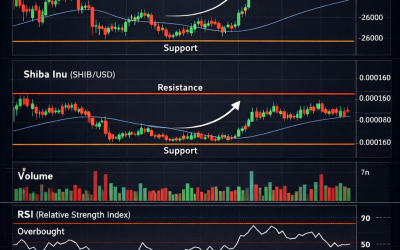
3. Mark Support and Resistance Levels
Use horizontal lines to mark previous swing highs and lows. For example, Bitcoin recently broke above its previous resistance of $88K with strong volume — a bullish sign.
4. Watch Volume for Confirmation
Volume confirms the strength of a move. If XRP breaks above $2.10 with high volume, it’s likely to continue toward its next resistance at $2.40 (source).
5. Use Indicators Sparingly
Don’t clutter your chart. Stick to 2-3 key indicators such as:
- RSI: Overbought above 70, oversold below 30
- Volume: Track buying/selling pressure
- MACD: Momentum indicator for trend reversals
Trading Strategy #1: Trend-Following with Moving Averages
This strategy involves entering trades in the direction of the trend using EMAs.
Setup:
- Use 50 EMA and 200 EMA
- Buy when the 50 EMA crosses above the 200 EMA (Golden Cross)
- Exit if the 50 EMA drops below the 200 EMA (Death Cross)
Example: Bitcoin’s long-term Golden Cross in mid-2025 preceded the current $91K rally.
🔥 Ready to test this strategy? Open a free charting account on TradingView and practice EMA crossovers now!
Trading Strategy #2: Breakout Trades Using Support/Resistance
Look for price to break above resistance with volume.
Steps:
- Identify key resistance (e.g., XRP at $2.10)
- Wait for breakout with high volume
- Enter trade and set stop-loss below breakout level
- Target next resistance (e.g., $2.40 for XRP)
Pro Tip: Confirm breakouts with RSI or MACD to avoid fakeouts.
Strategy #3: RSI Divergence for Reversals
RSI divergence can signal potential trend reversals:
- Bullish Divergence: Price makes new low, RSI makes higher low
- Bearish Divergence: Price makes new high, RSI makes lower high
This is useful in sideways or uncertain markets. Combine with support zones for higher accuracy.
Advanced Tip: Watch the Venue You Trade On
Even in a bullish market, poor trade execution can eat your profits. As CryptoSlate reports, European traders face a “venue gap” — meaning fragmented liquidity across exchanges can cause slippage and worst execution.
Always check liquidity and spreads on the venue you use. Tools like CoinGecko or CoinGlass can help compare exchange depth.
How to Set a Basic Trade Plan
Before entering a trade, write down:
- Entry price
- Stop-loss level (e.g., 3-5% below entry)
- Target price
- Risk/reward ratio (aim for 2:1 or better)
Your goal isn’t to win every trade — it’s to manage risk and stay consistent over time.
Common Mistakes to Avoid
- Chasing pumps without confirmation
- Trading without stop-losses
- Using too many indicators
- Ignoring macro news (e.g., ETF inflows, regulations)
Where to Learn More
Want to deepen your TA skills?
- Watch The Chart Guys on YouTube
- Read BabyPips School of Pipsology (applies to crypto too)
- Practice live with demo accounts on Bybit or Binance
Final Thoughts: The Bull Run Is Here — Are You Trading Smart?
The 2026 bull run is unlocking massive opportunities, but you need a clear strategy and technical edge to capitalize on it. From EMA strategies to breakout plays and RSI signals, learn to read the charts and let the price action guide you.
📌 Don’t just HODL — trade with confidence. Bookmark this guide, and revisit it each week as you build your trading skillset.
Want weekly crypto trading setups and indicator tutorials sent to your inbox? Subscribe to our free Crypto TA newsletter here.



0 Comments