


Tired of guessing your next crypto move? Discover how to read charts and spot market signals that even billionaires like Michael Saylor use to make multi-million dollar decisions.
Why Chart Analysis Matters More Than Ever in Crypto
With Michael Saylor buying over $960M in Bitcoin, XRP plunging to $2, and Ethereum’s founder proposing a radical change, the crypto market is buzzing. But how do you make informed decisions in such a volatile environment?
The answer: technical analysis. Learning how to read crypto charts isn’t just for pros—it’s the gateway to smarter trades, better timing, and stronger portfolios.
Understanding the Basics: Candlesticks 101
Candlestick charts form the foundation of crypto technical analysis. Each candle shows four key pieces of data: open, high, low, and close prices within a specific timeframe.
- Green candles = price closed higher than it opened
- Red candles = price closed lower than it opened
- Long wicks = volatility; price was pushed but rejected
Pro Tip: Use the 4-hour and daily candles for medium-term trend confirmation.
Key Patterns to Watch
Certain patterns repeat themselves across timeframes. Spotting them early can help you act before the crowd:
- Double Bottom: Often signals a bullish reversal.
- Head and Shoulders: Indicates a bearish trend reversal.
- Bull Flags: Continuation pattern in an uptrend. Watch for breakout volume.
If you’re seeing extreme fear like with XRP’s recent dip, historical chart patterns show these can often precede a bounce.
Use Support & Resistance Zones
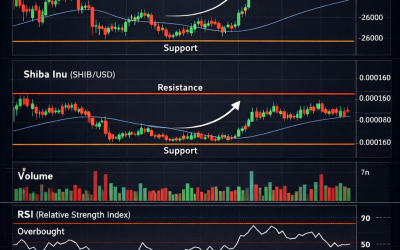
One of the most powerful and easily applicable tools is identifying key support and resistance levels. These are price zones where the market repeatedly bounces or rejects.
- Use daily and weekly charts to draw these levels.
- Observe volume: higher volume at a level = stronger zone.
For instance, Dogecoin recently bounced off a 3-month low support, with on-chain data signaling a trend reversal. That’s a textbook support setup.
Indicators That Actually Work
Indicators help confirm what the price action is telling you. Here are three you should learn to use immediately:
1. RSI (Relative Strength Index)
Ideal for spotting overbought (>70) or oversold (<30) conditions. Combine it with horizontal support/resistance for high-probability entries.
2. Moving Averages (MA)
Use the 50 and 200-day MAs to understand the broader trend. Golden crosses and death crosses are widely respected signals.
3. MACD (Moving Average Convergence Divergence)
MACD crossovers often precede major trend shifts. Use alongside RSI for confirmation.
Actionable Strategy: The Bounce & Breakout Method
If you’re unsure when to buy or sell, try this simple yet effective strategy:
- Identify a strong support zone on the 4H or Daily chart.
- Wait for price to wick into that zone and form a reversal candle (e.g. hammer or engulfing).
- Confirm with RSI <30 and increasing volume.
- Set stop-loss just below the wick.
- Set targets at the next resistance level or 2x risk-reward.
This setup works particularly well for volatile assets like XRP or meme coins like DOGE, where panic often provides opportunity.
Ethereum’s Gas Fee Prediction Market: A Game Changer?
Vitalik Buterin’s recent proposal to create a gas-price prediction market could massively improve Ethereum usability. For traders, lower gas = cheaper entries and exits.
From a technical perspective, ETH’s consolidation with low gas fees may be a calm before the storm. Watch for breakout volume above recent resistance levels.
How to Spot the Next Big Altcoin
Looking for the next 10x altcoin? Here’s a framework from the article on breakout tokens:
- Scan for coins up 5–10% on a red day (relative strength).
- Check Twitter, Telegram, or Reddit for buzz—volume usually follows hype.
- Verify the breakout with bull flag or inverse head & shoulder pattern.
- Set entries on retest of breakout point + volume confirmation.
Always combine fundamentals (team, roadmap, utility) with chart signals. Even speculative plays like meme coins can yield results when backed by data.
CTA: Want More Real-Time Chart Analysis?
👉 Join our free Telegram group where we post chart setups, live trade ideas, and technical breakdowns every day. Click to join now.
Risk Management: The Hidden Skill of Every Winning Trader
- Never risk more than 1–2% of your portfolio per trade.
- Use stop-losses consistently. Emotion is the enemy of profit.
- Use a journal to track every trade: entry, exit, reason, outcome.
Even if you’re wrong 50% of the time, proper risk management can make you profitable over the long term.
Closing Thoughts: Start Reading Charts Today
Whether you’re watching Bitcoin’s price after Saylor’s billion-dollar buy or scanning for the next microcap altcoin breakout, your edge lies in the charts.
Practice daily. Backtest your strategies. Look at where volume clusters. And most importantly, stay disciplined.
CTA: ✉️ Subscribe for Weekly Trade Setups
Don’t miss breakout altcoins or chart patterns. Subscribe to our free weekly email with high-confidence trade setups and analysis before the market moves.



0 Comments