


With Bitcoin rebounding from a massive $2.5 billion liquidation and institutional whales like Binance buying the dip, there’s never been a more critical time to sharpen your technical analysis skills. Learn how to decode price action and chart patterns to stay ahead of the next big move.
Why Technical Analysis Matters in Today’s Crypto Market
The crypto market in early 2026 is on fire—but not without its shocks. Bitcoin (BTC/USD) recently plummeted to nine-month lows, triggered by macroeconomic uncertainty like Kevin Warsh’s nomination to the Fed and a series of massive liquidations. Despite that, BTC is showing signs of recovery, trading around $78,000–$79,000.
Institutions like Binance are scooping up $100M worth of BTC—and may deploy up to $1B more. Meanwhile, German banks are opening the floodgates for mainstream crypto access. How should YOU trade in this high-stakes environment?
Answer: Master technical analysis. It’s not just about charts—it’s about reading emotions, narratives, and institutional behavior embedded in price action.
1. The Basics: Understanding Crypto Charts
There are three primary types of crypto trading charts:
- Line Charts: Good for beginners but too simplistic.
- Bar Charts: Show open, high, low, and close (OHLC) but can be visually confusing.
- Candlestick Charts: Most popular among traders. They visually capture market psychology within specific time frames.
Example: A long green (bullish) candle suggests strong buying pressure. A long red (bearish) candle shows aggressive selling.
2. Key Candlestick Patterns to Watch
- Doji: Indicates indecision. Can signal a reversal when appearing after a strong trend.
- Hammer: Bullish signal after a downtrend. Long wick shows sellers tried and failed.
- Engulfing: When one candle fully “engulfs” the previous one. Bullish engulfing after a downtrend = potential reversal.
For a full candlestick cheat sheet, download this free resource from TradingView.
3. Volume: The Lifeblood of Market Moves
Volume confirms price action. If Bitcoin pumps but volume is low, the move could be a fakeout. On the other hand, rising volume during upward moves signals strength.
Use Tip: Overlay volume with candlesticks. Look for volume spikes at key support/resistance zones.
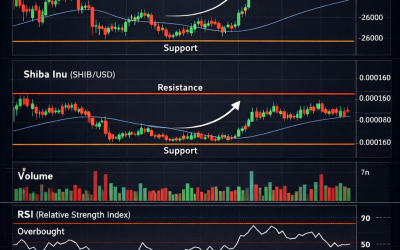
4. Support & Resistance: Your Crypto GPS
Support is a price level where buying interest typically steps in. Resistance is where selling pressure mounts.
To identify these zones:
- Look for historical bounce or rejection points.
- Use round numbers like $75,000 or $80,000 as psychological levels.
Pro Tip: Combine support zones with high volume nodes for high-conviction trades.
5. Moving Averages: Trading With the Trend
Popular Moving Averages:
- 50-Day MA: Short-to-mid term trend
- 200-Day MA: Long-term investor sentiment
When the 50-day crosses above the 200-day, it forms a Golden Cross—a bullish signal. The opposite is the Death Cross.
Example: BTC recently tested its 200-day MA after the Warsh shock. If it holds, a bounce is likely.
6. RSI – Relative Strength Index
RSI helps you understand if an asset is overbought (>70) or oversold (<30). Use this to time entries and exits.
Combine RSI with trendlines. A bullish divergence (price makes lower lows, RSI makes higher lows) is often a precursor to a reversal.
7. Fibonacci Retracement: Timing the Bounce
Use Fibonacci levels to spot potential bounce or retrace areas. Key levels:
- 0.382
- 0.5
- 0.618 – the “Golden Ratio”
If BTC retraces to the 0.618 level on strong volume, it’s often a great entry.
8. Actionable Trading Strategy: The Confluence Setup
Combine indicators for high-probability trades. Here’s how:
- Identify a support level via horizontal zone and volume profile.
- Look for bullish candlestick patterns.
- Confirm with RSI or MACD.
- Enter with a stop-loss just below the support zone.
- Take profit at the next resistance level.
Example: If BTC drops to $75,500 (support), forms a hammer candle, RSI reads 35, and volume spikes—this is your signal.
9. Use Layer 2 Signals and On-Chain Sentiment
Projects like Bitcoin Hyper are gaining traction. Use Layer 2 adoption rates, miner activity, and network fees as macro sentiment indicators.
Higher miner activity may suggest long-term confidence and could support bullish setups.
10. Risk Management: The #1 Rule
Never risk more than 1–2% of your capital on a single trade.
- Set stop-loss orders based on technical levels, not emotion.
- Use position sizing calculators.
Want a free trading journal template to track your setups and performance? Download it here.
Final Thoughts: Read the Room and the Chart
Crypto markets like today’s—highly volatile, institutionally significant, and globally uncertain—require more than just gut feelings. You must understand:
- Price action (candlesticks, support/resistance)
- Momentum (RSI, MACD)
- Volume and sentiment (whale activity, news catalysts)
With German banks lowering entry barriers and Web3 integrations like $SUBBD disrupting legacy industries, the future is coming fast. Don’t just HODL—trade with purpose.
📘 Ready to put these strategies into practice? Open a free account on Binance and start with test capital using these setups.
📈 Want more weekly setups and chart walkthroughs? Subscribe to our free newsletter and get real-time trading insights into your inbox.



0 Comments