


Crypto markets are heating up again in 2026 — but are you ready to ride the next wave? Discover how to read crypto charts like a pro and unlock high-conviction trading setups before they explode.
Introduction: Why Chart Reading Is Critical in the 2026 Crypto Market
The crypto market in 2026 is showing signs of renewed volatility and opportunity. While the overall market cap hovers at $3.18 trillion, daily momentum has been fluctuating. Bitcoin is holding strong at around $90,000, and altcoins like Cardano (ADA) are showing technical patterns reminiscent of earlier bull cycles.
Yet, many traders miss out on profits because they don’t understand how to properly analyze charts and spot breakout signals.
This article will give you a hands-on guide to reading crypto charts, identifying actionable patterns, and applying proven trading strategies for 2026 and beyond.
1. Understanding Candlestick Charts: Your First Step to Smarter Trades
Every crypto chart tells a story. And the language it speaks? Candlesticks.
A candlestick represents price action over a specific period (e.g., 1 hour, 1 day). Each candle shows:
- Open: Price at the start of the time period
- Close: Price at the end of the time period
- High: The maximum price reached during the period
- Low: The minimum price reached
Use green candles (bullish) to spot momentum and red candles (bearish) to detect trend weakness.
Pro Tip: Combine larger timeframes (like daily or weekly) with shorter ones (like 15-min or hourly) for multi-layered confirmation.
2. How to Use Support and Resistance to Time Entries
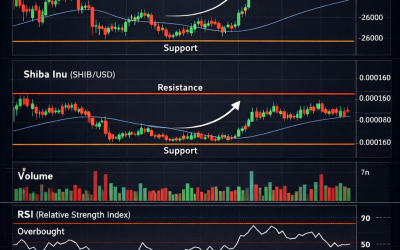
Support and resistance levels act like invisible walls that price often respects before breaking.
- Support = A price level where buyers step in (floor)
- Resistance = A level where sellers dominate (ceiling)
Draw these levels by connecting the horizontal zones of repeated tops and bottoms on the chart. Watch how Bitcoin is struggling to break the $108K resistance — this is classic resistance in action.
3. The Breakout Strategy: Catching the Big Moves Early
Breakouts happen when price bursts through a well-defined area of support or resistance — often on increased volume.
Here’s how to trade them:
- Identify a clear range (e.g., Bitcoin between $89K–$91K)
- Wait for a candle to close above resistance or below support
- Confirm breakout volume is above the 20-day average
- Enter on the next candle with a stop-loss just below the breakout point
Volume confirmation is your best friend. No volume? No trade.
4. RSI and MACD: Two Indicators You Must Know
Relative Strength Index (RSI)
RSI helps determine if an asset is overbought (above 70) or oversold (below 30).
Use it to:
- Avoid buying tops
- Find potential reversal points
MACD (Moving Average Convergence Divergence)
The MACD is a momentum indicator. Watch for:
- Bullish crossover: MACD line crosses above the signal line
- Bearish crossover: MACD line crosses below the signal line
Use MACD for trend confirmation before entering larger trades.
5. Real-World Example: Cardano’s $5–$10 Setup
According to technical analysis from Quantum Ascend, Cardano (ADA) is potentially exiting a corrective phase and may be targeting $5–$10, mirroring its 2020 breakout.
Here’s how you could trade it:
- Identify the lower trendline (support) holding since the correction began
- Enter on a breakout above $3.50 with strong RSI and MACD confirmation
- Set stop-loss just below $3.00 in case of a false breakout
CTA: Want to see real-time ADA breakouts? Watch Cardano charts live on TradingView.
6. Managing Risk: How to Protect Your Capital
No strategy works 100% of the time. That’s why capital preservation is critical.
Use these principles:
- Risk only 1–2% of your portfolio per trade
- Always set a stop-loss
- Use position sizing to adjust for volatility
If you’re trading an asset like Bitcoin with $1,000, and you’re risking 2%, your stop-loss should be no more than a $20 loss.
7. Volatility in 2026: What the Bitwise CIO Recommends
According to Matt Hougan, CIO of Bitwise, three key factors will drive crypto in 2026:
- Real-world adoption (payment platforms, DeFi, etc.)
- Institutional investment diversification
- Regulatory clarity
These macro signals help validate your technical setups. For instance, if ADA shows a breakout and Cardano gets a major protocol upgrade or partnership, the stars align.
CTA: Looking for macro updates in real time? Subscribe to CoinDesk’s Markets section and stay a step ahead.
8. Bonus: How Prediction Markets Can Guide Sentiment
Prediction markets like Polymarket, now partnered with Dow Jones, are becoming relevant tools for gauging crowd expectations. Despite insider trading concerns, they reflect emerging sentiment that traders can use for directional bias.
Watch how market participants are betting on ETF approvals, presidential elections, or major protocol upgrades — these can influence crypto flows indirectly.
Conclusion: Your 2026 Action Plan
Crypto in 2026 is not about hype — it’s about precision. Whether you’re swing trading Bitcoin’s $108K breakout or positioning for Cardano’s $5–$10 cycle, the foundation is always chart analysis and disciplined execution.
Here’s your quick-start checklist:
- Master candlestick and volume interpretation
- Identify key levels and breakout opportunities
- Use RSI and MACD to confirm momentum
- Apply strict risk management
- Monitor macro and sentiment trends
The market rewards patience, preparation, and precision.
Ready to take your trading to the next level? Start analyzing charts and take control of your crypto journey today.



0 Comments