
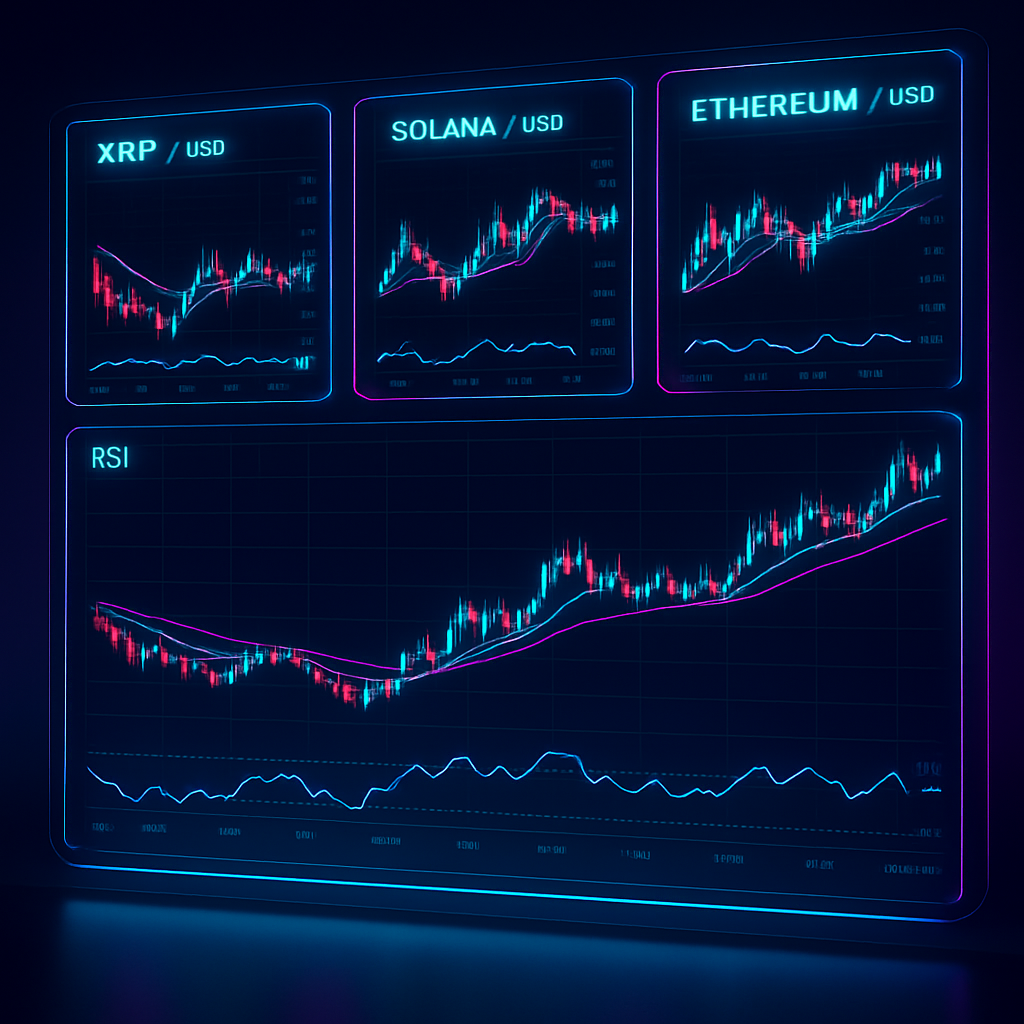

Struggling to make sense of sideways markets or sudden price moves in XRP, Solana, or Ethereum? Learn how to read charts, identify breakout patterns, and spot fakeouts—before your next trade.
Introduction: Why Technical Analysis Matters More Than Ever
As we close out 2025, crypto markets have entered a phase where volatility is tamed, but opportunity is abundant—if you know how to read the signs. XRP is hovering near $1.87 with a potential breakout above $2.10, Solana is consolidating under $140 amid Wall Street signals, and Ethereum’s staking congestion is distorting network sentiment. The common thread? Technical analysis is becoming the go-to tool for spotting profitable entries and exits.
In this article, we’ll break down actionable trading strategies using real market examples, teach you how to read crypto charts intuitively, and help you avoid common traps that cost beginner traders money.
1. Reading Key Support & Resistance Levels
Let’s start with the basics: Support and resistance levels mark the price zones where buyers or sellers consistently appear. Think of them as psychological floors and ceilings.
Looking at XRP, the $1.87 level has held as support. A move past $2.10 could signal a breakout. In this XRP analysis, that $2.10 zone is critical. Why? Because it historically acted as a rejection point.
Trading Tip: Use horizontal lines on your charting platform (like TradingView) to mark support/resistance—then wait for clear reactions before entering trades.
2. Spotting Breakouts (And Avoiding Fakeouts)
Breakouts occur when price moves beyond a support or resistance level with volume confirmation. The key word here is volume—without it, fakeouts are common.
Solana’s recent setup around $122.80 has traders watching for a push toward $140. According to the Solana prediction article, volume has dried up—a red flag for breakout traders.
How to confirm a breakout:
- Price closes above resistance on the 4-hour or daily chart
- Volume is at least 20% above the 20-day average
- RSI is not overbought (below 70)
Avoid buying into the breakout candle itself. Instead, wait for a retest of the breakout zone—typically, price pulls back to confirm the breakout before continuing.
3. Using Moving Averages to Identify Trends
Moving averages smooth out price data to show the direction of the trend. The most popular are the 50-day and 200-day moving averages.
Ethereum’s recent congestion from staking inflows has masked its price structure. But zooming out, the 50/200 MA cross (aka the Golden Cross or Death Cross) helps clarify trend direction.
Strategy: Trade with the trend. If 50 MA is above 200 MA, only look for longs on pullbacks. If the 50 MA is below, wait for shorts or stay on the sidelines.
👉 Want to practice with real charts? Open a free TradingView chart here and overlay MAs.
4. RSI and MACD: Momentum Indicators That Actually Work
Momentum indicators help confirm if a move has strength. The two most reliable are:
- RSI (Relative Strength Index): Overbought at 70+, oversold below 30
- MACD: Shows bullish/bearish crossovers and histogram momentum
Let’s say XRP hits $2.10. If RSI is already at 80, and MACD is flattening, be cautious—that’s the setup for a pullback.
Pro tip: Use RSI divergence (price makes higher high, RSI makes lower high) to spot early signs of reversal.
5. Volume Profile: Hidden Clues Behind Price Action
Volume Profile shows how much trading occurred at each price level—great for spotting accumulation zones and breakout levels.
Ethereum’s staking congestion has shaken up its volume profile. According to this analysis, a corporate treasury locked up huge amounts of ETH, skewing sentiment. Look for volume nodes (high trading interest) around $2,000-$2,200 to identify safe zones.
💡 Volume gaps often act like magnets—price tends to fill them.
6. Using Chart Patterns the Smart Way
Patterns are visual representations of market psychology. Don’t treat them like magic—combine them with volume and indicators.
Most reliable patterns:
- Ascending triangle (bullish)
- Head and shoulders (bearish)
- Double bottom (bullish reversal)
Solana, for example, is forming a slow ascending triangle—higher lows under $140 resistance. A breakout could be explosive if volume confirms.
Trading idea: Set alerts just above pattern resistance, but only enter if breakout candle has above-average volume.
7. Risk Management: The Real Secret to Long-Term Success
You can have perfect entries—but without risk management, one mistake wipes out weeks of gains.
Golden rules:
- Risk no more than 1-2% of your capital per trade
- Use stop-losses (never remove them)
- Position size based on your stop distance—not your emotions
📈 New to position sizing? Try this free calculator: Position Size Calculator
8. Macro Signals and Regulation as Technical Catalysts
Don’t ignore the macro. Regulatory shifts in 2025 have strengthened the case for long-term crypto adoption. According to this regulatory roundup, 2025 focused on infrastructure over ideology.
How to use this as a trader: Infrastructure = confidence. Rising institutional adoption (like Wall Street’s interest in Solana) often precedes price breakouts. Monitor tweets, press releases, and on-chain flows for early signals.
9. Candle Formations You Should Know
Don’t treat every candle as equal. These three formations are worth memorizing:
- Doji: Indecision—wait for confirmation
- Engulfing candle: Signals possible reversal
- Hammer/inverted hammer: Potential bottoming/top signals
Practice spotting these on daily charts. Combine with RSI to boost accuracy.
Conclusion: Build Your Crypto Edge
Whether you’re trading XRP’s $2.10 breakout, riding a Solana wave toward $140, or interpreting Ethereum’s staking noise, one thing is clear: technical analysis gives you an edge.
Apply the strategies above and make them part of your trading system. Don’t chase pumps. Instead, work with patterns, volume, and signals that give you confidence.
Ready to elevate your trading game? Start tracking these patterns in real-time and build your crypto playbook in a free TradingView account. Sign up here.
📚 Want a deeper dive on charting strategies? Download our free Crypto Chart Reading Guide PDF—get it here.




0 Comments